Funeral services, Unit 621 and more…
Click here: https://conta.cc/3J72PhY
Los Angeles County Professional Peace Officers Association

by Greg Torres
Funeral services, Unit 621 and more…
Click here: https://conta.cc/3J72PhY
by Greg Torres
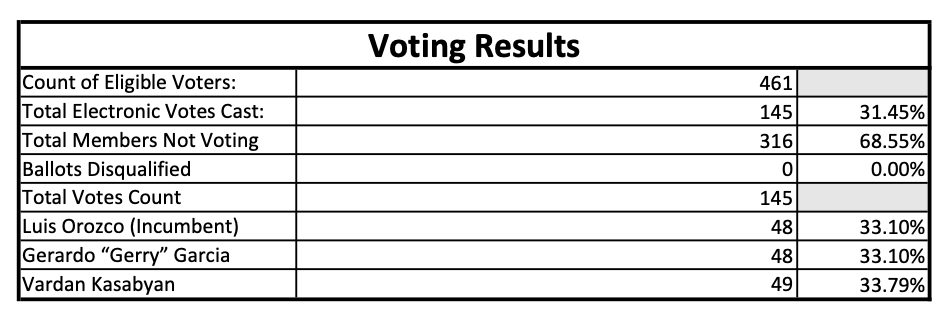
LACERA election, CA graduation and more…
Click here: https://conta.cc/45me5P5
by Greg Torres
LA Times
8/10/25
By Gustavo Arellano
https://www.latimes.com/california/story/2025-08-10/mike-fratantoni-lasd-historian

When an explosion killed three L.A. County sheriff’s deputies last month, Mike Fratantoni thought about 1857.
A horse thief named Juan Flores broke out of San Quentin State Prison, joined a posse that called itself Las Manillas — the handcuffs — and headed south toward Southern California. They robbed stores along the way and murdered a German shopkeeper in San Juan Capistrano. Los Angeles County Sheriff James R. Barton was warned about them but ignored the danger. He and his men were ambushed. Four were killed — Barton, Deputy Charles Daly and constables Charles Baker and William Little. The spot, near the interchange where State Route 133 and the 405 Freeway meet in Irvine, is now called Barton Mound.
Orange County was still a part of L.A. County then, the population was just over 11,000, California was a newly minted state, and the Mexican period was giving way to the Wild West.
“They all died alone with no help coming,” said Fratantoni, the Sheriff’s Department’s staff historian. “Today, you know your partner is coming to help you. People say the job’s dangerous now — it’s never not been dangerous.”
So as Sheriff Robert Luna prepared to hold a news conference hours after the accident at a department training facility in East L.A. took the lives of Dets. Joshua Kelley-Eklund, Victor Lemus and William Osborn, Fratantoni sent over notes about what happened to Barton and his men. That’s how Luna was able to tell the public that the latest line-of-duty deaths to befall the department happened on its deadliest day in more than 160 years, a line quickly repeated by media across the country.
Fratantoni describes himself as the “default button” whenever someone has a question about the Sheriff’s Department’s past, whether it’s a colleague or the public, whether it’s about the positive or the scandalous. He can tell you why female deputies stopped wearing caps (blame the popularity of beehive hairdos in the 1960s) and reveal why longtime Sheriff Eugene Biscailuz was a pioneer in trying to rehabilitate addicts (his father was an alcoholic).
It’s a job the Long Island native has officially held for a decade. He assumed the position with the blessing of then-Sheriff Jim McDonnell to tap into a passion Fratantoni had dabbled in on his own almost from the moment he joined the department in 1999.
“You can’t talk about L.A. County history without us,” Fratantoni said when we met at the Hall of Justice. Outside, the flags remained at half-staff in honor of the dead detectives. He was taking me on a tour of the building’s basement museum, which showcased the histories of the L.A. County Sheriff’s Department, district attorney’s office and coroner. “We’ve been there from Day 1. We were here before the Board of Supervisors. We were here before LAPD. We’ve never closed. We’ve survived it all.”
“We check with Mike on everything,” Luna told me in a phone interview. Last year, the sheriff joined Fratantoni and other current and retired Sheriff’s Department members for the dedication of a plaque to commemorate the 1857 Barton Mound massacre. “You get 10 minutes with him, and wow.”
I was able to get two hours.
Fratantoni is burly but soft-spoken, a trace of a New York accent lingering in his by-the-books cadence. All around us were books, poster boards and newspaper headlines of criminals that Angelenos still remember and those long forgotten, people such as Winnie Ruth Judd, who murdered two friends in Phoenix in 1931 then traveled to Los Angeles by train with their bodies in trunks.
We passed through a row of original L.A. County jail cells that were brought down piece by piece from their original location on the 10th floor of the Hall of Justice. He pointed out a display case of makeshift weapons, tattoo needles and fake IDs created by inmates over the department’s 175 years. I stared too long at a black jacket and AC/DC hat worn by the Night Stalker — serial killer Richard Ramirez.
The museum receives free rent from L.A. County but is otherwise funded and maintained by the Sheriffs’ Relief Foundation and the dollar a month pulled from the paychecks of Sheriff’s Department employees who sign up to support — “We don’t want to be a burden,” Fratantoni explained. It’s not open to the general public, but he frequently hosts deputies, prosecutors, law students and even school field trips.
“The kids come and love this one for some reason,” he said with a chuckle as we passed a narcotics display. “Not my favorite one.”
Fratantoni never rushed me and turned every question I had into a short story that never felt like a lecture. He frequently apologized for random artifacts strewn around — plaques, movie posters, a biography of mobster Mickey Cohen — or displays not lit to his liking. “Am I putting you to sleep yet?” he joked at one point.
The 45-year-old is more than a curator or nerdy archivist. Luna, like his predecessors Alex Villanueva and McDonnell, has entrusted Fratantoni to not just help preserve the department’s history but also imprint its importance on the men and women who are its present and future.
“I have always been a fan of history,” said Luna, who has organized lunchtime lectures about the department and civil rights. For Black History Month in February, Fratantoni spoke about the troubles faced by deputies William Abbott and John Brady, who in 1954 became the department’s first integrated patrol unit.
The recriminations against Abbott, who was Black, and Brady didn’t come from within but rather the residents in West Hollywood they served. “I believe it’s important to teach our deputies where we’ve been and some of the challenges we’ve faced. You can’t help but to want to listen to his stories,” Luna said of Fratantoni.
“Mike is just phenomenal,” said Deputy Graciela Medrano, a 25-year-veteran who was also at the museum the day I visited. A black ribbon stretched across her badge — a sign of mourning, law enforcement style. “I’ll ask him about cases that happened when I was just starting, and he immediately knows what I’m talking about. He makes us all appreciate our department more.”
Every year, Fratantoni speaks to the latest class of recruits about the department’s history. “They know it’s been around but nothing else. So I share photos, I tell stories. And I tell them, ‘You’re getting a torch passed to you, and you’re going to run the next leg.’ You can see their reactions — our history gives them a sense of purpose.”
He’ll also attend community events with other deputies in vintage uniforms or old department cars. “Someone will see it and say, ‘That’s my granddad’s car’ and smile. We can have conversations with the public we otherwise wouldn’t be able to.”
Fratantoni was supposed to focus this year on the department’s 175th anniversary. Another goal was to seek out an interview with Shirley MacLaine, one of the last surviving queens of the Sheriff’s Championship Rodeo, an annual event that used to fill up the Memorial Coliseum and attract Hollywood A-listers.
But 2025 got in the way. We spoke a week before the burials of Osborn and Kelley-Eklund (the services for Lemus have yet to be announced). Fratantoni also sits on the committee charged with putting names on the Los Angeles County Peace Officers’ Memorial.
“I don’t like doing it, and I hope I don’t have to fill out paperwork for it ever again, but if that’s what I have to do, I’m honored to be a part of it,” he said. “I hold it close to my heart.”
Even the work commemorating what happened during the Barton Mound massacre remains unfinished. The victims were buried at the old City Cemetery downtownbut were moved to Rosedale Cemetery in Mid-City in 1914. No one bothered to mark their new graves, which were lost until researchers discovered them a few years ago. Fratantoni and others are fundraising for new tombstones for their slain predecessors.
He mentioned Daly’s story: Born in Ireland. Came to California for the Gold Rush. Became a blacksmith — he put the shoes on the horses that Barton and his constables were going to use to pursue Las Manillas. A strong, able man whom Barton deputized so he could join them on the day they would all die.
“It’s sad to see people who lost their life be forgotten,” Fratantoni said. “That’s just…”
The historian tasked with talking shook his head in silence.
by Greg Torres
PPOA BBQ location change, support for families of 3 fallen deputies, and more…
Click here: https://conta.cc/4577urK
by Greg Torres
Tragedy Claims Lives of 3 Deputies…
Click here: https://conta.cc/40X4BIw
by Greg Torres
Use of force, CalAIM, and more…
Click here: https://conta.cc/4nOyjJO
by Greg Torres
https://www.accessduarte.com/government/departments/public-safety/emergency-services/sheriff-services/meet-your-duarte-sergeant

Sergeant Lamont E. Dobbins Jr. officially began his assignment in Duarte in May 2025 after being selected from a highly competitive pool of candidates. His appointment reflects not only his exceptional qualifications but also his longstanding commitment to public service and mental health advocacy.
Sgt. Dobbins brings a unique blend of law enforcement leadership and mental health expertise. Before joining the Sheriff’s Department, he spent seven years with the Los Angeles County Department of Mental Health as a Care Coordinator. There, he led five multidisciplinary teams in outreach efforts that connected vulnerable individuals across the county to critical housing and support services.
Since joining the Los Angeles County Sheriff’s Department in 2007, Sgt. Dobbins has amassed over 17 years of field experience in various vital roles. He was initially assigned to Men’s Central Jail (custody) and subsequently to Lomita Station, where he worked as a patrol deputy. After several years on the streets, Sgt. Dobbins became a member of the COPS (Community Oriented Policing Services), collaborating with residents to mitigate violent crime. Leveraging his extensive experience in mental health services, Sgt. Dobbins joined the Mental Evaluation Team (MET), providing crisis intervention and support to individuals facing psychiatric emergencies. With a solid foundation in crisis intervention and support, Sgt. Dobbins moved to the Risk Assessment and Management Program (MET/RAMP) team, where he focused on assisting individuals with severe mental illness through comprehensive case management and follow-up. In 2022, Sgt. Dobbins was promoted to the position of Sergeant and was assigned to the Century Regional Detention Facility. During his tenure at CRDF, Sgt. Dobbins oversaw the mental health housing unit, maintaining his commitment to high-needs populations and safety.
In 2024, Sgt Dobbins transferred to Temple Station and began serving the San Gabriel Valley community. His educational background includes a B.S. in Public Administration from CSU Dominguez Hills and an M.S. in Criminal Justice from Tiffin University.
Sgt. Dobbins’ arrival marks an exciting new chapter for the Public Safety Department. His passion for bridging the gap between mental health and law enforcement, his commitment to proactive outreach, and his deep understanding of community engagement make him a tremendous asset.
Welcome to the Duarte Satellite Station’s official web page. This facility, situated at 1042 Huntington Drive, was established in 1995 to enhance services for the residents of Duarte, Bradbury, and the Monrovia County region. We offer law enforcement services and engage in various outreach initiatives to positively impact our communities. Our objective is to address the diverse needs of our community. Please do not hesitate to contact us for information on any topic. Community Policing represents a collaboration between the citizens of our community and those of us who deliver public safety services.
For us to achieve success, your support and cooperation are essential. A secure community is one where neighbors look out for one another and individuals are willing to assist law enforcement. I urge you to contact us if you have any questions or concerns, and to become actively involved.
Sergeant Lamont Dobbins
Temple/Duarte Satellite Station
(626) 357-7938 Ext. 304
by Greg Torres
Retirement prep, legal hearing, and more…
Click here: https://conta.cc/44wsBDd
by Greg Torres
Click here to read Los Angeles Magazine Story
Gretchen Deutsch / May 21, 2025
As overtime spending soars past half a billion dollars, LA County Sheriff’s Deputies face exhaustion, severe understaffing, and growing concerns over public safety.
LA County sheriff’s deputies are stretched thin, and the Los Angeles County Sheriff’s Department is on track to spend over $500 million in overtime this year.
In the last fiscal year alone, the LA Sheriff’s Department spent $458 million on overtime. With $131 million already spent in just the first three months of 2025, the department is on pace to break its own record.
County data shows that more deputies are leaving the force than being hired, due in large part to the plummet in recruitment during the Covid-19 pandemic – a decline that the agency has yet to recover from. There are currently 1,530 unfilled deputy positions, in addition to a significant number of deputies out on leave. Despite the decrease in filled deputy positions, the job’s demands persist. The remaining deputies are picking up the slack, shouldering the workload of the thousands of vacant positions.
“I have seen firsthand the physical and mental fatigue our deputy sheriffs are experiencing due to excessive overtime,” Rosemead Mayor Margaret Clark said in a concerned letter to the Board of Supervisors.
Some deputies work up to 100 hours of overtime each month–a grueling pace that raises serious safety concerns. The physical exhaustion and mental strain can leave them ill-equipped to make the split-second, life-or-death decisions the job demands. Even those who benefit financially from the overtime admit the toll is too high, and they would rather have a break.
“It is almost like Los Angeles County is running an experiment to see how far they can push their first responders without catastrophic consequences,” Richard Pippin, president of the deputy union, told ABC News.
The issue is not primarily about money–deputies got a raise last year and the funds to train new deputies have been approved–but rather a matter of staffing and time. There simply are not enough people or hours in a day to expect peak performance from the existing force.
by Greg Torres
June 7, 2025
LASD Deputy Hospitalized in Lancaster Shooting
A Los Angeles County Sheriff’s deputy was hospitalized Saturday night following a shooting in Lancaster.
The shooting occurred around 7:20 p.m. after deputies were responding to a robbery call in the 1200 block of Meadow View.
Deputies exchanged gunfire with the suspect, according to the LA County Sheriff’s Department. One of the deputies and the suspect were both struck.
The person suspected in the robbery died at the scene. Details about the crime were not immediately available.
The deputy was hospitalized in critical condition after being shot in the abdomen, LASD said.